
If you ask a leader how AI-ready their workforce is, you'll probably hear about upskilling activities: webinars, an AI hub on the intranet, lunch-and-learns, and thousands of employees reached. These metrics matter, but they don't answer the question that counts: how capable are our people with digital tools and AI? In most organizations, the honest answer is that we don't know. Companies are investing heavily in AI while flying blind on the skills that decide whether it pays off. In this blog post, we introduce Storyals Digital Skills Navigator, a new way to measure what people can actually do with AI - not just what they say they can do - and share early findings that surprised us.
Why usage data can’t measure digital dexterity
Three years ago, we started building an AI-based productivity coach that would adapt to each person's digital literacy and personalize their learning experience. We assumed data from Microsoft Graph - including which tools people use, how often they use them, and how they collaborate - would provide us with sufficient insights into their digital proficiency. It didn't! Usage data shows what people do, not how well they do it. Someone who opens Teams fifty times a day might be a skilled collaborator or might be drowning in notifications. To personalize learning meaningfully, we needed insight into each person's actual digital dexterity. This led us on a new quest: finding a reliable way to measure digital and AI skills.
Built on research, not guesswork
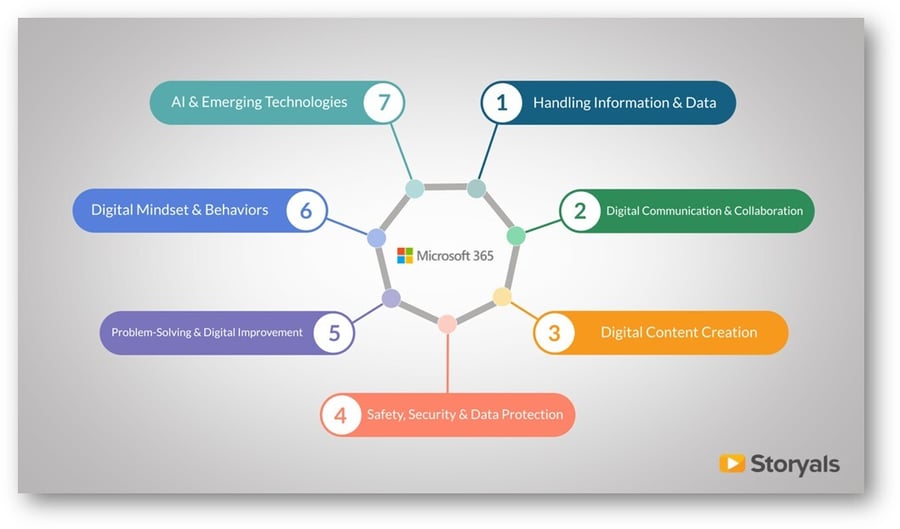
We didn't want to invent yet another skills model, so we built on established research. The backbone is DigComp, the European Commission's Digital Competence Framework, developed by its Joint Research Centre. It was first published in 2013 and has been updated several times since. The latest edition, DigComp 3.0, brings AI into the framework systematically and adds new learning outcomes. We covered the main digital skills frameworks in an earlier post, How digitally savvy is your organization? DigComp is deliberately general, so it needed a workplace layer on top. For that, we worked with Digital Work Research and Elizabeth Marsh, author of the Digital Workplace Skills Framework. The result is an integrated model of seven digital skill domains, built specifically for how people work in Microsoft 365 and Microsoft 365 Copilot.
-
Handling information and data: finding, interpreting, and organizing information across systems.
-
Digital communication and collaboration: working together through the right channels.
-
Digital content creation: creating content that's fit for professional use.
-
Safety, security and data protection: cyber hygiene, careful handling of sensitive data, and policy in practice.
-
Problem-solving and digital improvement: resolving issues, adapting to new tools, and improving how work gets done.
-
Digital mindset and behaviors: confidence, learning agility, digital professionalism, peer support, and digital wellbeing.
-
AI and emerging technologies: choosing tools safely, using AI outputs critically, AI-supported automation, and transparency.
Two perspectives, one personal roadmap
Storyals Digital Skills Navigator is a research-based assessment of digital and AI capability in the Microsoft 365 workplace. It combines two perspectives:
- Self-assessment: 35 questions about confidence, behaviors, and ways of working.
- Scenario-based assessment: 14 open-response questions built around realistic workplace situations, where people show how they'd actually handle a task.
Each participant then gets a personalized report with:
- an overall assessment of their digital dexterity in Microsoft 365 Copilot
- a weighted score for each of the seven domains
- recommendations for improving in each domain
- articles, guidance, and courses for further learning.
The goal isn't to grade people. It's to give each person a clear starting point and a practical way forward.
Early findings: what people think they can do isn't what they can do
The early data has already challenged some common assumptions about measuring digital skills.
Self-assessments alone aren't reliable. So far, we see no significant correlation between what people think they can do and what they can actually demonstrate, in any of the seven domains. If your skills strategy relies on surveys that ask people to rate themselves, you may be building on sand.
The confidence curve is real. This is the Dunning-Kruger effect. People who know very little tend to be overconfident, while people who know a lot often become less sure of themselves. Anyone who has learned something complicated will recognize the journey from "of course I know this" through "there's more to this than I thought" to "it's finally starting to make sense."
%20shadow.jpg?width=900&height=541&name=The%20confidence%20curve%20(Dunning-Kruger)%20shadow.jpg)
Seeing the gap increases motivation. When people see the difference between how they rated themselves and what they demonstrated, they're more motivated to learn. The gap doesn't discourage them. It gives them a reason to act.
Calibration matters as much as capability. The idea we find most important is metacognitive calibration: how well someone's view of their own skills matches their real skills. It can go wrong in two ways:
- Overconfidence: people overestimate themselves and stop learning because they think they've already arrived.
- Underconfidence: capable people underestimate themselves, so they hold back, don't volunteer, and don't experiment with new tools.
The second one matters a lot for AI adoption. Your organization may already have capable people who aren't exploring Copilot and AI agents because they don't believe they're ready. Making capability visible can unlock the experimentation that real adoption depends on.
Visibility is the missing piece in AI adoption
AI adoption rarely stalls because of the technology alone. It stalls when people lack the skills, confidence, and habits to use it well, and when organizations can't see where those gaps are. That visibility is what we set out to create with Digital Skills Navigator: a research-based view of digital dexterity that shows each person where they stand and what to do next.
Whether or not you use the Navigator, three questions are worth asking about your approach to AI skills:
- Evidence: Are you measuring learning activity, or real capability?
- Calibration: Do your people have an accurate picture of their own strengths and gaps?
- Hidden potential: Who is more capable than they think, and how could you encourage them to experiment?
Individual reports are only the start. We're now building an organizational dashboard that helps leaders see capability patterns across groups, focus learning investment where it matters most, and track progress over time. If you'd like to test Digital Skills Navigator with a group of at least 10 employees, contact us to join our Early Access Program.